Getting Around Bangkok: The Only Transport Guide You Need
This post contains affiliate links. If you book accommodation, tours, or buy products through these links, I may earn a small commission at no extra cost to you. This helps support the site and keeps the content free.
Bangkok’s traffic is legendary for all the wrong reasons, but the city has quietly built one of the best public transport networks in Southeast Asia, and once you understand the handful of systems, getting around is cheap, fast and mostly air-conditioned. I live here, and this is the exact system I hand to every friend and family member who visits. It pairs well with my honest take on how many days you need in Bangkok, and the wider Thailand travel guide covers everything beyond the capital.
Before you land: the ten-minute setup
Three things sort your first hours out. Fill in Thailand’s free Digital Arrival Card online; it is required for every visitor and only accepts submissions within 72 hours of arrival, so do not do it too early. Set up a tourist eSIM before you fly with Saily (code thattravelblog saves you 10%) so you land already connected and skip the airport SIM queue entirely (True and AIS are the local networks if you would rather buy a physical SIM on arrival). And download two apps: Grab, Thailand’s super app for pre-paid taxis and food delivery, and MuvMi, which we will get to, because it is the most underrated way to move around this city.
The BTS Skytrain: your best friend
The elevated BTS is the backbone of visitor Bangkok. Two main lines matter: the Sukhumvit Line (running through Siam, Asok, Thonglor, Ekkamai, On Nut and beyond) and the Silom Line (Sala Daeng, Chong Nonsi, Saphan Taksin for the river). Trains run roughly 5.15am to midnight, every few minutes.
Fares are distance-based, roughly 17 to 65 baht depending on how far you ride. For a heavy sightseeing day, the 150 baht One-Day Pass pays for itself quickly. If you are here longer, grab a Rabbit Card from any ticket office (200 baht: a 100 baht issuing fee plus 100 baht of credit, passport required), which skips the ticket-machine queue. Current fares and passes are on the official BTS site.
One thing to know: Thailand’s much-publicised 20 baht flat fare scheme applies to Thai citizens registered through a government app, so visitors pay standard fares. Do not let a headline set your expectations.
The MRT: the underground partner
The MRT Blue Line is the BTS’s underground sibling and, for visitors, arguably the more exciting one: it stops at Wat Mangkon (the doorstep of Chinatown and Talat Noi), Sanam Chai (right by Wat Pho and the Old Town) and Chatuchak. New fares came in on 3 July 2026: 17 to 44 baht depending on distance.
In 2026 the MRT scrapped its old stored-value cards entirely and went contactless. You now just tap a Visa or Mastercard with the contactless symbol at the gate, which makes the MRT the easiest system in the city for visitors. Bring a bank card with foreign fees turned off and you never queue for a ticket. The BTS and MRT are still separate systems though, so your Rabbit Card stays in your pocket down here. They connect at Asok/Sukhumvit, Mo Chit/Chatuchak Park and Sala Daeng/Si Lom.
River boats that double as sightseeing
The Chao Phraya Express Boat is public transport disguised as a river cruise. The orange flag boat is the local workhorse, now a flat 18 baht to anywhere on the route, and it is the best way to reach the Grand Palace, Wat Arun and the Old Town while skipping traffic entirely. The blue flag tourist boat adds English commentary and a 150 baht hop-on-hop-off day pass. Connect from BTS Saphan Taksin at Sathorn Pier.
My favourite version of this is a loop I do with every visitor: start at Tha Tien Pier for temple views from the water, hop off at Wang Lang Market for snacks and people-watching, then carry on up to Phra Athit Road for a riverside drink. You have technically been commuting the whole time; it feels like a day out.
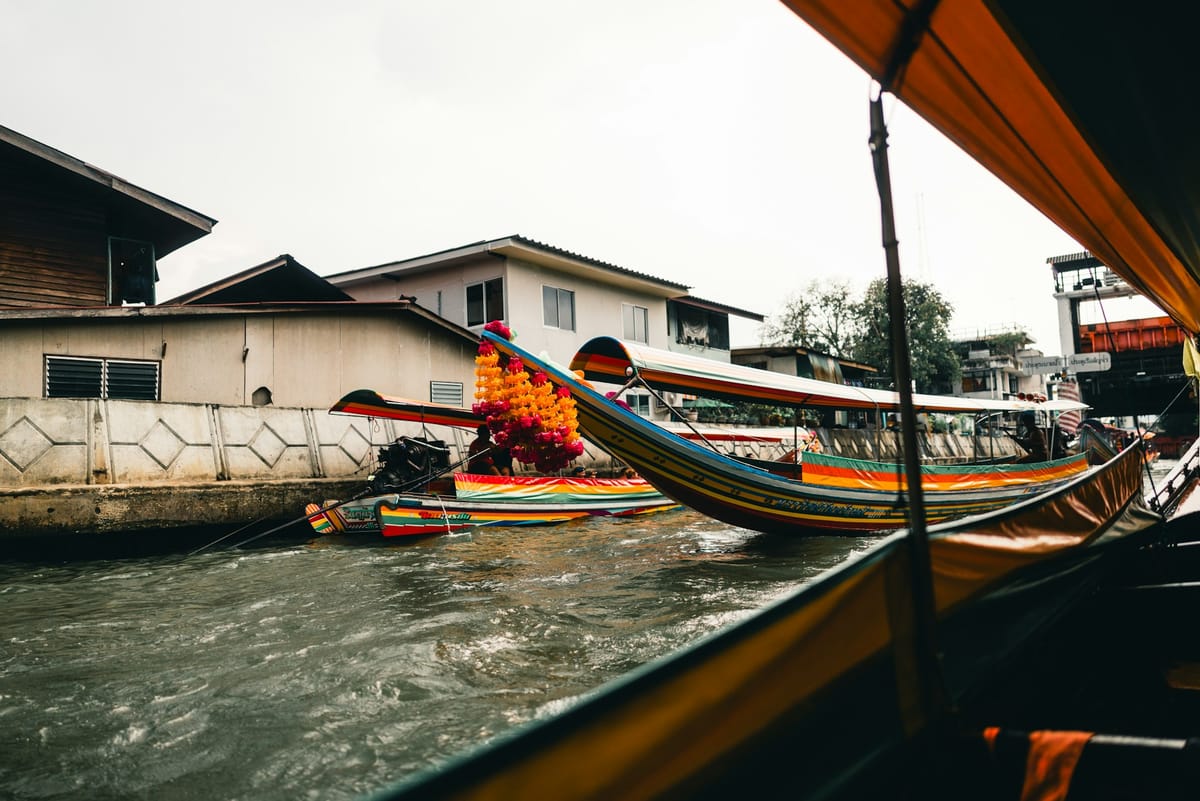
A long-tail charter through the Thonburi khlongs, the most memorable half-day I know in Bangkok.
Two deeper cuts. The Khlong Saen Saep canal boats rocket commuters between the Old Town area and central Bangkok, and riding one is an experience in itself: hold on to your bag and mind the splash. And over on the Thonburi side, you can charter a cheap private long-tail boat and weave through the khlongs past stilt houses and riverside temples, which I rate as the most memorable half-day in Bangkok. I usually pair it with the giant Buddha at Wat Paknam.
Grab and taxis
Grab is Thailand’s Uber and the stress-free option: fixed prices, no haggling, cashless, and a record of every trip. Short hops typically run 80 to 200 baht. I ride my own scooter these days, but Grab is what I put every visitor on; transport is one of the cheapest parts of life here, as my breakdown of what it costs to live in Bangkok shows.
Regular metered taxis are everywhere and cheap, and the meter goes on or you get out. Drivers parked outside major hotels, the Grand Palace and Khao San Road are the most likely to try a “flat rate.” Just wave down a moving cab instead.
MuvMi, motorbike taxis and tuk tuks
MuvMi is the one most visitors have never heard of, and it is brilliant: electric tuk tuks you book through an app, with fixed fares shown upfront. A typical journey runs around 30 to 50 baht, rising to 70 or so for longer rides, and higher again if you want an express trip or the whole tuk tuk to yourself rather than a shared one. You top up a wallet in the app, pick shared or private, and scan a QR code to board. It runs 6.30am to 10pm daily in set zones, and the Old Town zone (Khao San, Grand Palace, Chinatown) is perfect for temple days. All the tuk tuk fun, none of the haggling.
The orange-vested motorbike taxi riders clustered at every soi mouth are how Bangkok actually moves at rush hour: brutally effective for short distances, priced per hop, helmet hopefully included. For anything under two kilometres in traffic, nothing beats them.
Classic tuk tuks, honestly? They are a fun ride, not a transport system. Agree the price before you get in, expect to pay more than a taxi, and treat it as the fairground attraction it is. Any driver offering a suspiciously cheap “city tour” is taking you shopping at his cousin’s suit shop.
Cycling the city on Anywheel for 10 baht
For parks, riverside stretches and short flat hops, there is a genuinely lovely option: Anywheel, the dockless bike share dotted all over the city. You unlock a bike by scanning its QR code in the app, and it costs 10 baht for every 30 minutes, which is close to free. Bikes and e-bikes sit at stations near the big parks and BTS stations, so it is perfect for looping the best parks in Bangkok like Benjakitti or Lumpini, or bridging that last kilometre from the train to your hotel. A 50 baht day pass covers unlimited 30-minute rides, and inside Benjakitti it is free to ride between 6am and 5.30pm, signposted at the park, so looping the Green Mile can cost you nothing at all. Just be sensible about where you cycle: Bangkok’s parks and the quieter sois are a joy, its main roads are not.
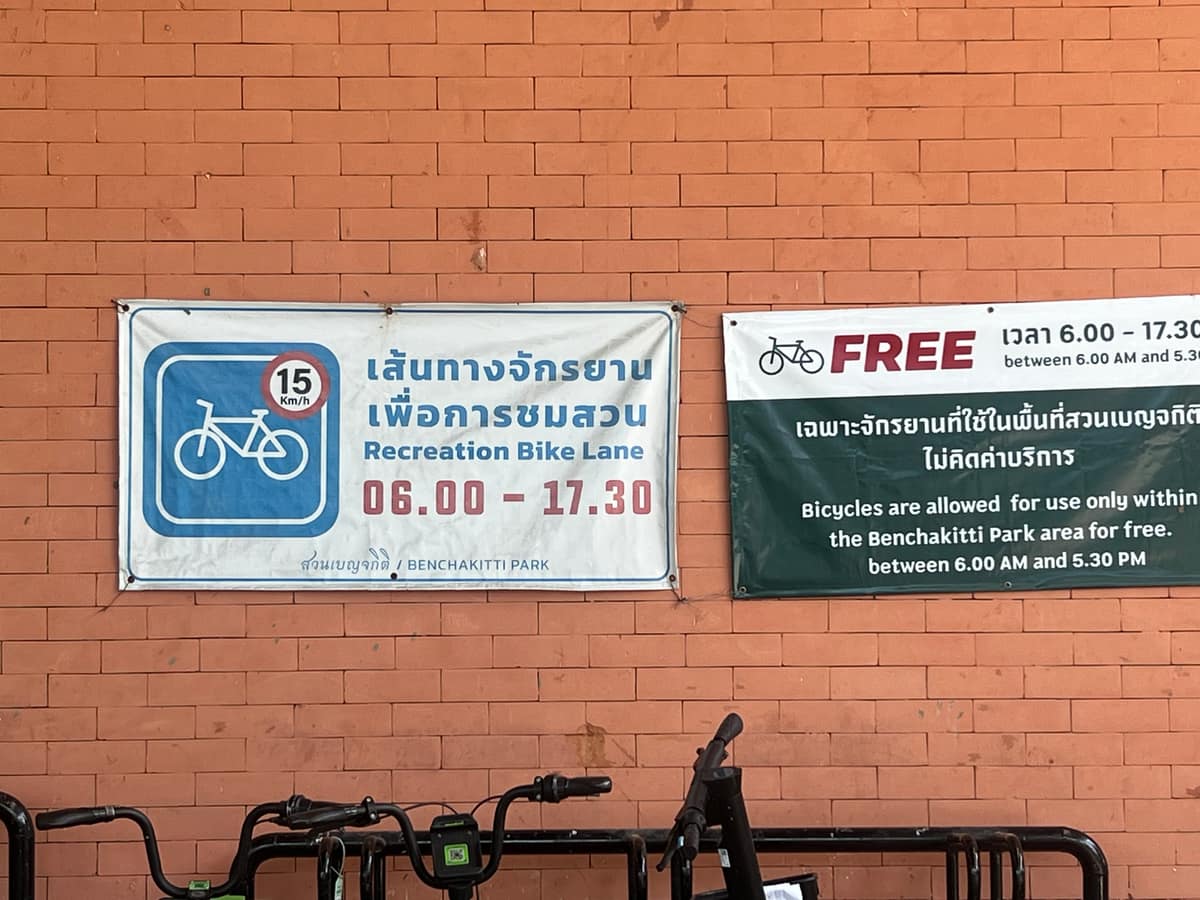
The sign says it plainly: bikes are free inside Benjakitti between 6am and 5.30pm.
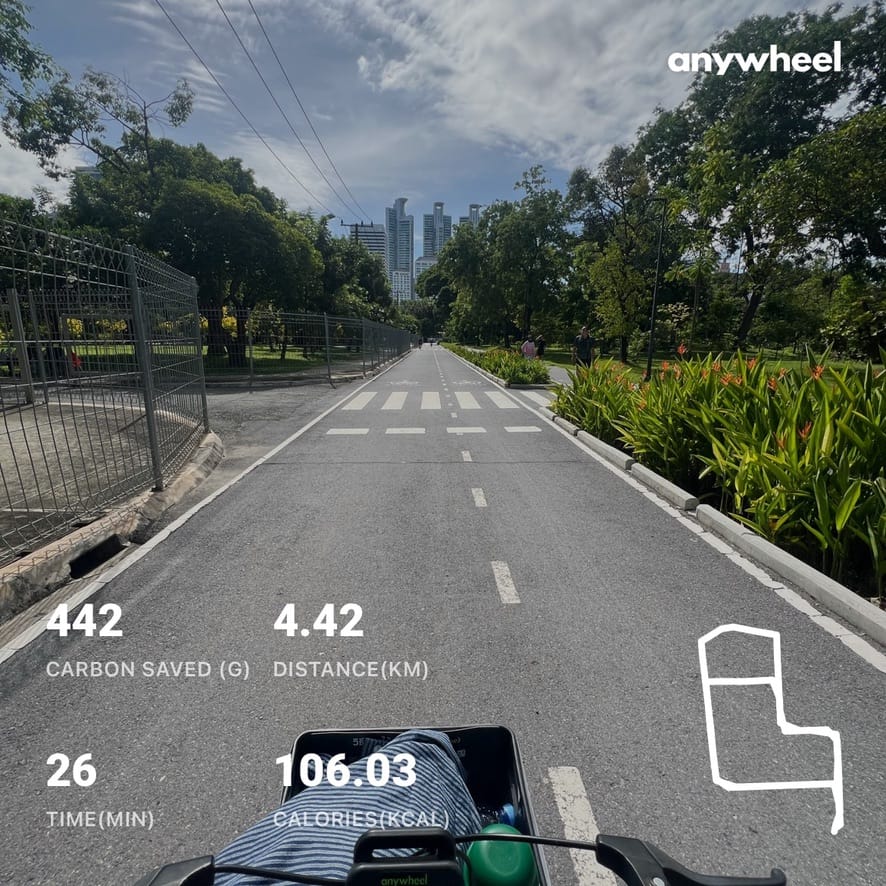
An Anywheel loop through Benjakitti: 4.4km for the price of a bottle of water.
Airport connections
From Suvarnabhumi, the Airport Rail Link runs to Phaya Thai station in about 26 minutes for 45 baht, where you connect to the BTS. From Don Mueang, the SRT Dark Red Line commuter train or a taxi are your options. Late at night, or if you are landing with family and luggage, either Grab it or prebook a private transfer so someone is waiting with a sign.
Bangkok transport FAQ
What is the best way to get around Bangkok?
The BTS Skytrain and MRT cover most visitor destinations quickly and cheaply. Combine them with river boats for the Old Town, MuvMi electric tuk tuks for short hops, and Grab for everything else.
How much does the BTS cost in Bangkok?
Fares are distance-based, roughly 17 to 65 baht per trip. The 150 baht One-Day Pass offers unlimited BTS rides and pays off on busy sightseeing days.
Can I use my credit card on Bangkok trains?
On the MRT, yes: since mid-2026 the gates take contactless Visa and Mastercard directly, so you tap in like a local. The BTS still uses its own tickets and the Rabbit Card.
Can tourists use the 20 baht train fare in Bangkok?
No. The 20 baht flat fare scheme requires registration with a Thai ID, so visitors pay standard distance-based fares.
Do Bangkok taxis use meters?
By law, yes. If a driver refuses the meter and quotes a flat price, decline and hail another cab, or use Grab for fixed upfront pricing.
Is the river boat a good way to get around Bangkok?
Yes. The orange flag Chao Phraya Express Boat is a flat 18 baht, runs frequently, and is the fastest route to riverside sights like the Grand Palace and Wat Arun.