What to Eat in Bangkok: A Street Food Guide That Skips the Tourist Menu
This post contains affiliate links. If you book accommodation, tours, or buy products through these links, I may earn a small commission at no extra cost to you. This helps support the site and keeps the content free.
I am not going to pretend there is a definitive list of Bangkok street food. The city is enormous, there are thousands of vendors, and the best bowl of noodles I have eaten this year came from a cart I could not find again if you paid me. There is no top ten, and I would be a little suspicious of anyone who says there is.
What I can give you instead is more useful: the dishes worth chasing, how to say them out loud, and the road I actually eat on.
One rule before you start: find the stall that sells one thing. A cart that has perfected a single dish over twenty years will beat a forty-item photo menu every single time. If the menu has pictures and spans four cuisines, keep walking.
What counts as street food here
Worth clearing this up, because “street food” in Bangkok covers a wider spectrum than the phrase suggests.
At one end there is food that is literally on the street: a cart, a wok, a couple of plastic stools on the pavement, packed away by midnight. At the other end there are shophouse institutions, places with walls and a roof and forty years of history, that everyone still calls street food because that is where they started and that is what they cook.
Both are worth your time, and both get called street food here. Almost everything below sits at the street end, which is deliberate: carts, stools and pavements are what I actually eat, and I suspect it is what you came for.
The dishes to chase
Learn to say these and you can eat well anywhere in the city. Nobody expects perfect tones, and the effort alone gets you a long way.
Pad kra pao (ผัดกะเพรา, say “pat gra-pow”). Pork or chicken stir-fried hard with holy basil, chilli and garlic, over rice, crowned with a fried egg with crispy edges. Forget pad thai: this is the true national dish, the thing half the city eats for lunch. Ask for it with kai dao to get the egg. Any single-dish rice stall will do you proud.
Boat noodles (ก๋วยเตี๋ยวเรือ, say “guay teow reua”). Small, intense bowls of dark spiced broth with pork or beef. The portions are tiny by design, so order three or four and stack the bowls like everyone else. The alley by the canal at Victory Monument is the classic pilgrimage, and bowls run about 12 to 20 baht each.
Fish ball noodles (ก๋วยเตี๋ยวลูกชิ้นปลา, say “guay teow look chin pla”). Springy hand-made fish balls in a clear, peppery broth, with noodles of your choosing. One of my favourite bowls in the city, and Chinatown does the best of it, as below.
Khao man gai (ข้าวมันไก่, say “cow man gai”). Poached chicken over rice cooked in the chicken fat, with a ginger and soybean sauce that is the entire point, plus a clear broth on the side. Deceptively plain, quietly perfect. Mostly a morning-to-early-afternoon dish, and the good places sell out.
Som tam (ส้มตำ, say “som tam”) and moo ping (หมูปิ้ง, say “moo bing”). Green papaya salad pounded to order, and grilled pork skewers straight off the charcoal. The great Thai street combination, ideally eaten on a plastic stool with a bag of sticky rice. Ask for pet nit noi (a little spicy) and mean it.
Larb (ลาบ, say “laap”). Minced meat tossed with toasted rice powder, lime, chilli and herbs. The heart of Isaan food, and the thing I order more than anything else in this city.
Bamee (บะหมี่, say “ba-mee”). Springy egg noodles, usually with pork or wontons, served dry or in broth. Order them haeng (dry) and you get the noodles tossed in the seasoning with the soup on the side, which is the better way round.
Guay jub (ก๋วยจั๊บ, say “guay jup”). Peppery rolled rice noodles with pork belly in a broth that will clear your head. A Chinatown speciality that too many visitors skip. Their loss.
Hoy tod (หอยทอด, say “hoy tord”). A crispy-edged oyster or mussel omelette, best from a vendor with a well-seasoned pan and a steady queue.
Jok (โจ๊ก, say “jok”). Thai rice porridge with pork, ginger and a raw egg stirred through until it disappears. The breakfast of champions, and the best hangover food in Asia.
Khao niao mamuang (ข้าวเหนียวมะม่วง, say “cow neow ma-muang”). Mango sticky rice. You know this one. Just make sure the mango is in season (April to June is the peak) and the coconut cream is poured fresh rather than sitting in a tub.
For the wider Thailand list, including the northern dishes you will not find on a Bangkok pavement, see the food section of my Thailand travel guide.
The Rama IV corridor: where I actually eat in Bangkok
A local’s food list clusters. You eat near where you live and where you travel, and a list spread neatly across a city this size is nearly always a list assembled from other lists. Mine clusters along Rama IV, the long road running east from the edge of Chinatown, and I have stopped apologising for it.
The happy accident is that the MRT Blue Line runs under Rama IV for most of its length, which makes this one of the easiest food runs in the city: one road, one train, four stops, most of the good stuff. Here it is west to east, station by station. The getting around Bangkok guide has the detail on the trains themselves.
Hua Lamphong: Yaowarat and Chinatown
The western end of the road, and the best eating in Bangkok by a distance. Yaowarat after dark is one of the few tourist-facing experiences here that entirely lives up to itself: grilled river prawns, roll noodles, curries ladled out of steel pots, mango sticky rice down the side sois. Peak chaos is roughly 7pm to 10pm. Get off at Hua Lamphong, or one stop further at Wat Mangkon to land in the middle of it. I have written a whole guide to Chinatown, Song Wat and Talat Noi if you want to make a proper evening of it. If it is your first night and you would rather someone else did the ordering, a guided Chinatown food tour is a genuinely good way in, and you will end up eating things you would never have picked yourself.
By day, the standout near here is Urai Han Palo on Song Wat, a family shop that has braised Teochew goose for sixty years and now holds a Michelin Bib Gourmand. A plate is 250 baht, it is cash only, and it can sell out, so once it is gone, it is gone.
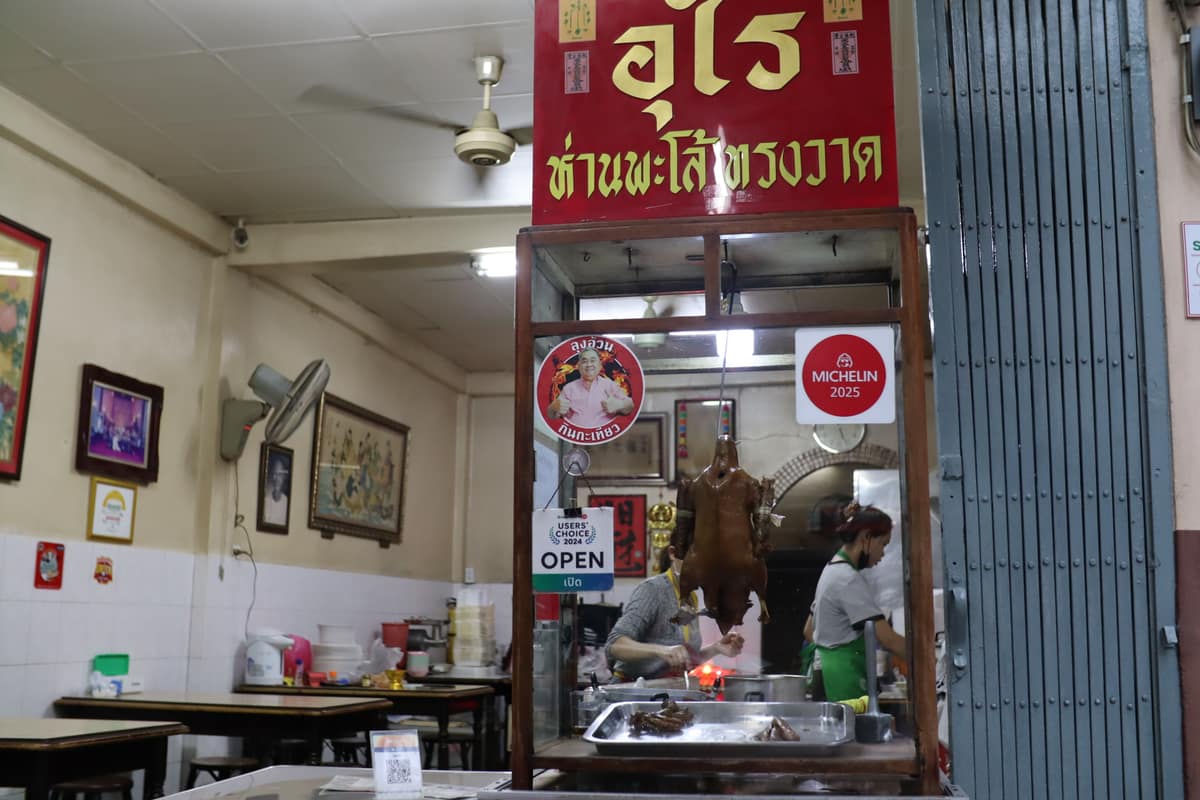
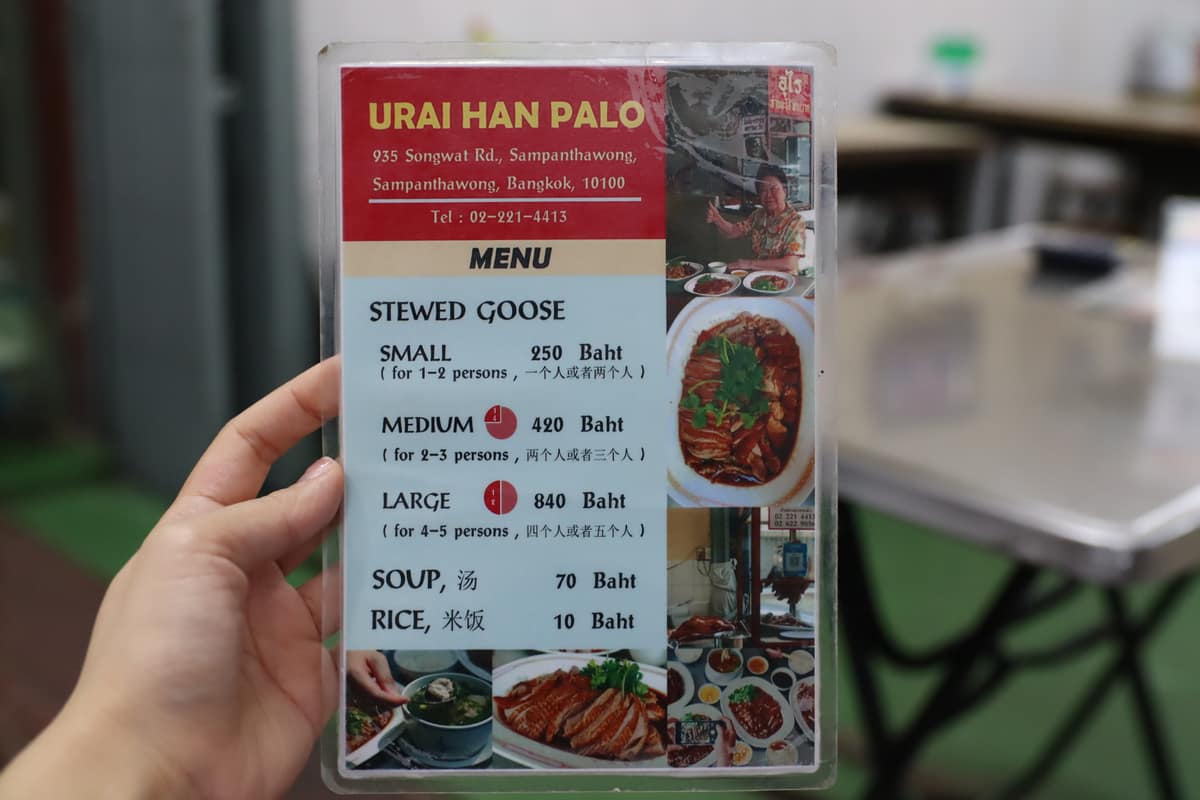
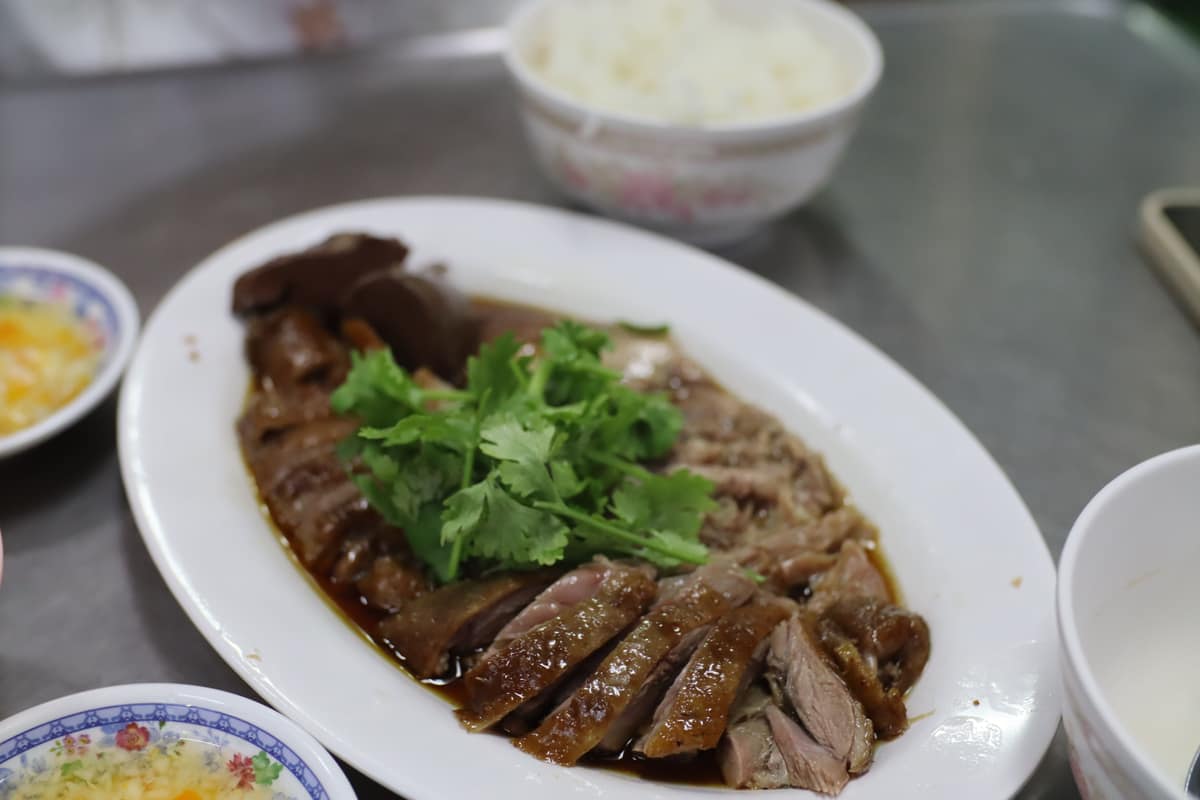
Urai Han Palo on Song Wat: sixty years of Teochew braised goose and a Michelin Bib Gourmand. It sells out quickly, so once it is gone, it is gone.
There is a daytime reason to come too: the fish ball noodles above, which are near the top of my personal list. Take a stroll down Song Wat Road, the quiet riverside street I send everyone down anyway, and you will find two famous stalls around the corner from one another: Lim Lao Sar (ลิ้มเหลาเส้า), the one I go to, and Lim Lao Ngow (ลิ้มเหล่าโหงว) a couple of streets over, which I keep meaning to try. Both are carts with a few metal tables and stools on the pavement, and either way you have chosen well.
Sam Yan: Banthat Thong
Where the current generation eats. Banthat Thong is a long, late, student-fuelled food street by Chulalongkorn University that has quietly become the most exciting eating in Bangkok: more polished than Yaowarat, and open later.
Tang Sui Heng does the duck noodles that pull me back here more than anything else. It opens at 4pm, so do not turn up at lunchtime and blame me. Jeh O Chula is on the same patch, the tom yum noodle hotpot with the queue you have seen on the internet.
Lumphini: the Si Bamphen pocket
Soi Si Bamphen is a low-key little pocket in Thung Maha Mek, which is technically Sathon rather than Lumphini, about seven minutes on foot from Lumphini station. It has no business being as good as it is. Two things here.
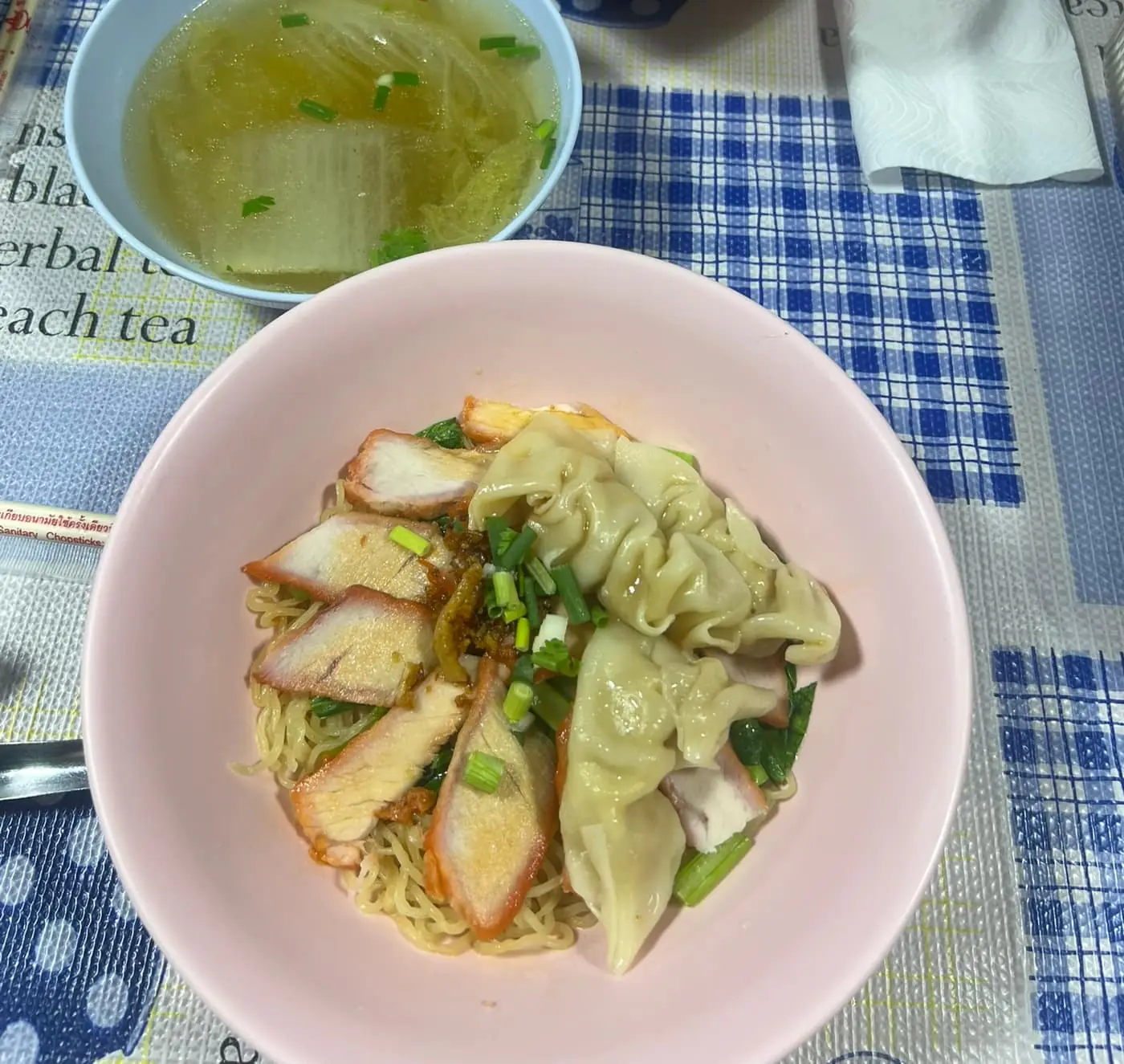
The best bamee in Thailand, and I was wrong about it. The best egg noodles I have eaten anywhere in this country come from a cart in this soi, and my wife, who is Thai and a great deal harder to please about noodles than I am, agrees. Sixty baht gets you egg noodles, red pork and wontons, with the soup alongside.
Now the part that took me a while to admit. The cart has no Google Maps listing of its own, and people even post their noodle photos onto the chicken rice shop’s listing next door by mistake, so for a long time I assumed I had stumbled on something secret. Then I actually looked at the sign. The big red number four, the Chinese characters: it is a Chaixi cart, part of a franchise with something like four and a half thousand outlets across Thailand.
So much for my hidden gem. Honestly, it is the better lesson: chase the food, not the mystique. I cannot tell you what this particular cart does differently, only that I have never had better, and that there are four and a half thousand more of them out there for you to try.
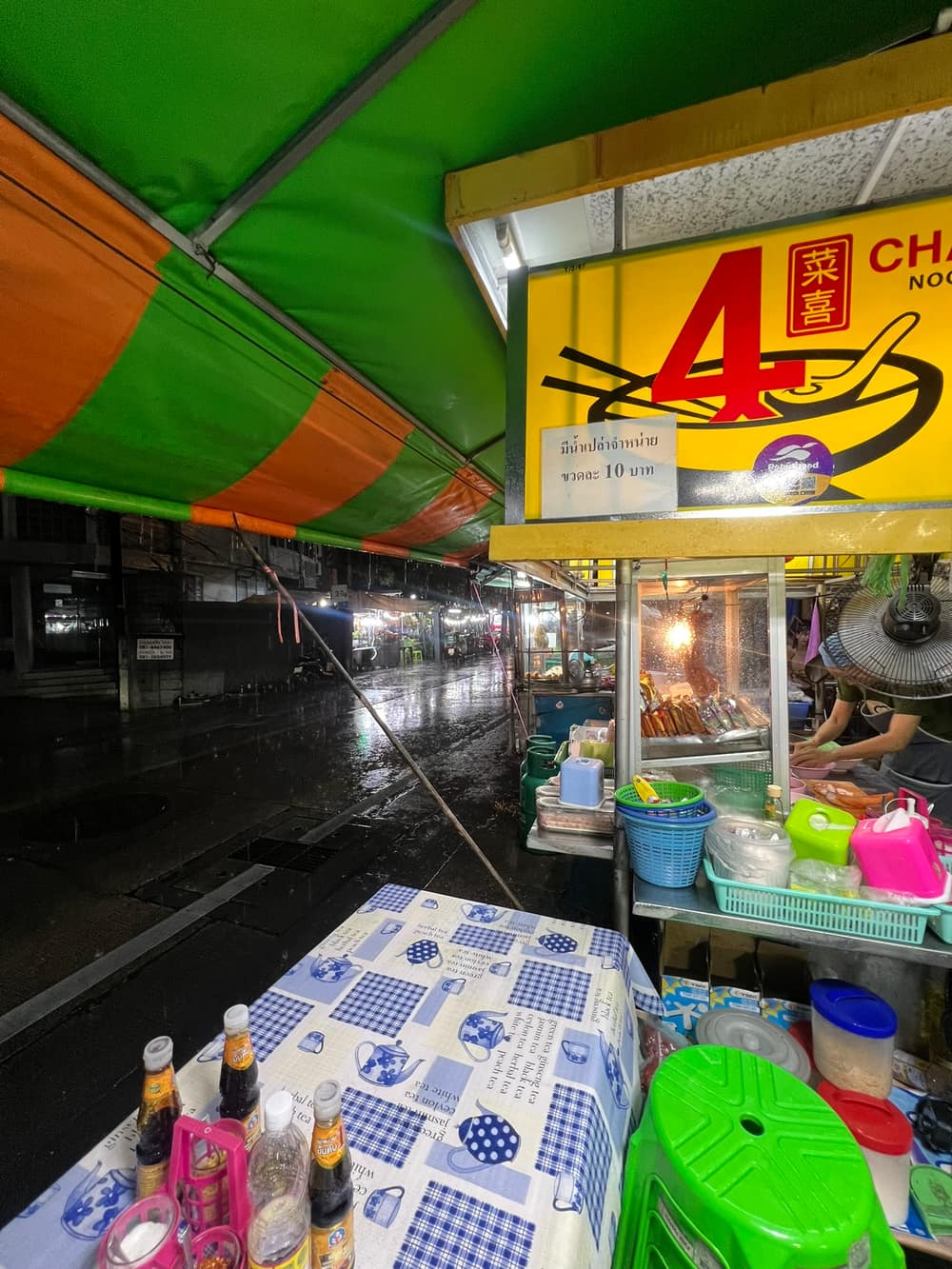
The cart in Soi Si Bamphen. That red number four is the giveaway I walked past for months.
ส้มตำอุบล หมูจุ่มผู้กองหวาน (Som Tam Ubon, Moo Joom Phu Kong Wan), 106 Soi Si Bamphen. Stools out on the pavement, a small room inside, and busy every single night. This is the social end of Isaan eating: people drinking, dishes landing whenever they are ready, nobody remotely in a hurry.
I go for the grilled chicken and sticky rice, which is exactly as simple and as good as it sounds. My wife orders the mushroom soup, and the raw spicy beef, which is a genuine Isaan delicacy and a step further than I have ever managed. Between you and the table, add the som tam, the grilled pork neck, and the moo joom itself, the herbal pork hot pot the place is named after. Open 11am until midnight, and plenty of dishes start around 10 baht. Show a driver the Thai and you will get there.
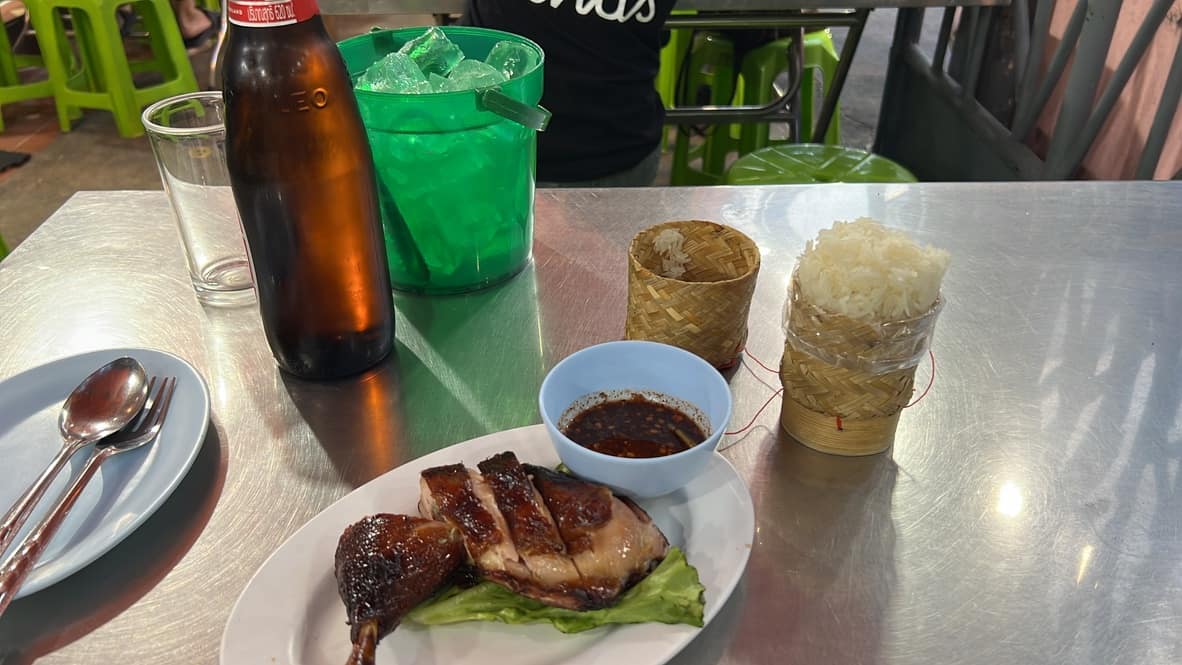
My order, and the whole point of the place: grilled chicken, sticky rice, jaew, and a cold one on a steel table.
Khlong Toei: ลาบเจริญ
ลาบเจริญ (Lab Charoen, also written Larb Chareon), 1262/1 Rama IV Road. My favourite place in this guide, and the one I come back to most. It sits on the side of a busy main road, which is the last place you would expect food this good.
The two to order are the spicy duck larb and the spicy pork salad. They are equally good and equally fierce, and both want a basket of sticky rice next to them. I lean towards the pork because it comes saucier. After that, the pork steak, the chicken wings, som tam and the corn salad. All properly authentic, none of it expensive.
Where Si Bamphen is a night out, this is somewhere you come specifically to eat. Same food culture, entirely different evening.
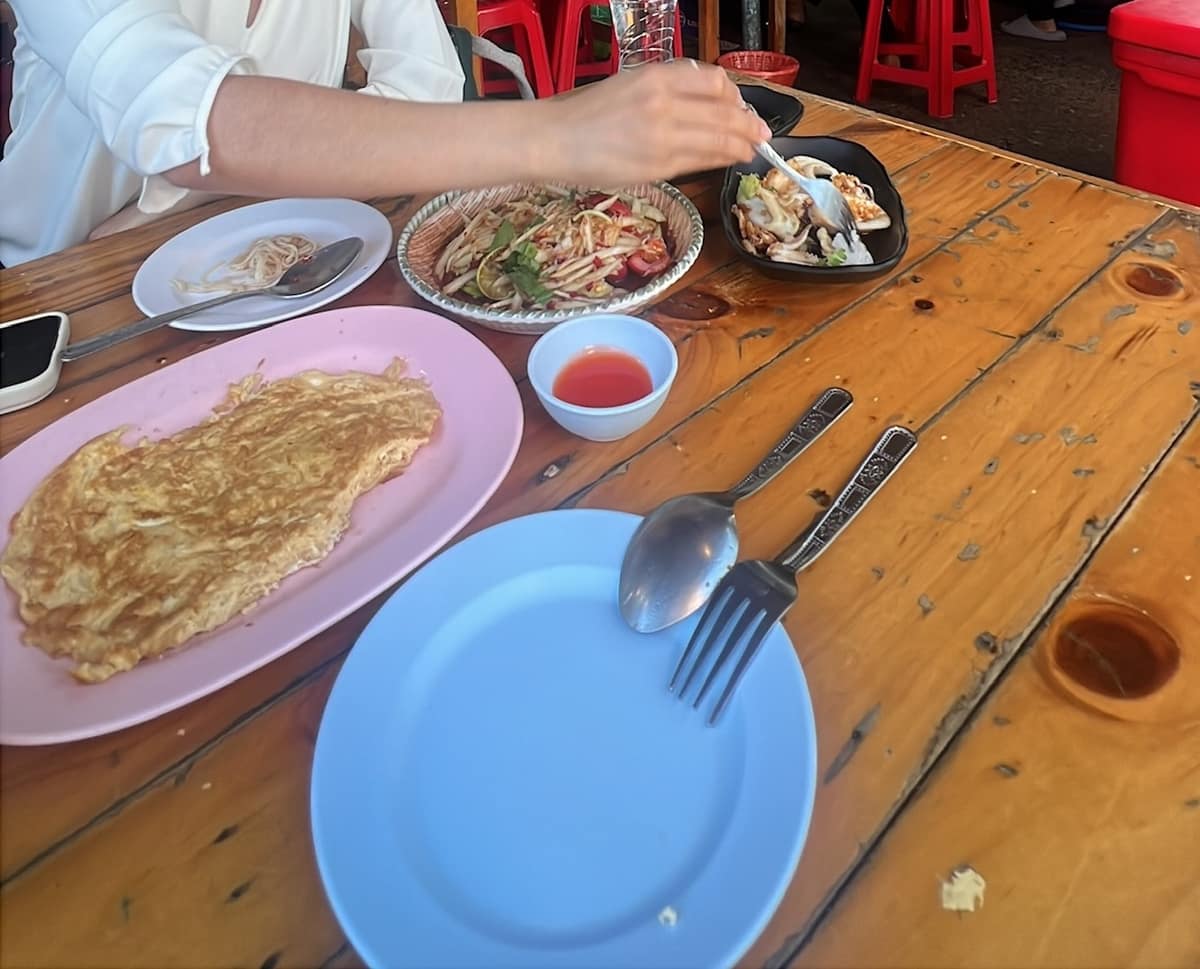
A table at Lab Charoen on Rama IV, where the food does all the talking.
Worth leaving the road for
Talat Phlu, over on the Thonburi side, is the one I would break the corridor for: an old food district most visitors never reach, where vendors have been making the same dishes for decades at prices set for the neighbourhood. Take the BTS Silom line to Talat Phlu and wander.
For a late one
I may as well admit it: a lot of my favourite food in Bangkok is Isaan, the fierce, herby, chilli-heavy cooking of the northeast, and a good deal of it is served long after other kitchens have shut. Two for when the night has got away from you.
ลาบอุบลคนตระการ (Laab Ubon Kontrakran), South Sathon Road. Proper Ubon-style Isaan, laab and som tam and grilled everything, going until 4am. It sits on Sathon itself rather than down a soi, so it is an easy one to fall into on the way home.
Laarb Lab Lab, Soi Pridi Banomyong 43 (Sukhumvit 71). A big, buzzing outdoor Isaan place on the east side of town that runs until 2am. The spicy Isaan dishes are the reason to come, but the one that catches people out is the Thai-style fish sashimi. It is busy enough that even the air-conditioned room, if you can find it, tends to be full. Take that as the recommendation it is.
Practical bits
Bring cash in small notes. Nearly every stall now takes Thai QR payment, which is genuinely everywhere here, but cards almost never.
The food poisoning reputation is wildly overstated. Freshly cooked food from a busy stall with high turnover is the safe bet, which is most of them. Eat where the office workers are queueing and you will be fine.
Timing matters more than people expect. Khao man gai and jok are morning food. Banthat Thong barely exists before 4pm. Yaowarat does not really start until the sun is down. Plan the day around the food, not the other way round.
The best few dollars you will spend
In Bangkok you can genuinely have one of the best meals of your life for the price of a couple of dollars, on a plastic stool at the side of the road.
Bangkok street food FAQ
What food is Bangkok famous for?
Bangkok is famous for street food: pad kra pao, boat noodles, som tam and moo ping, khao man gai, bamee, guay jub, larb, and mango sticky rice. Chinatown’s Yaowarat Road is the best-known place to eat it.
Is street food in Bangkok safe to eat?
Generally yes. Choose busy stalls that cook to order in front of you, and stick to sealed or bottled drinks. High turnover means fresh ingredients, which is why the queue is the best signal you have.
Where is the best street food in Bangkok?
Yaowarat in Chinatown is the best single street for an evening food crawl. Banthat Thong Road is where locals and students eat late, and the Si Bamphen pocket off Rama IV is where I eat most. Talat Phlu on the Thonburi side is the most local of the lot.
How much does street food cost in Bangkok?
Most dishes run 50 to 80 baht, roughly 1.50 to 2.50 US dollars. Boat noodles are cheaper still at 12 to 20 baht a bowl, because the bowls are tiny.
Do Bangkok street food stalls take cards?
Almost never, but nearly all accept Thai QR code payments. Carry cash in small notes as a backup.
What is the difference between street food and a shophouse restaurant in Bangkok?
Street food proper is cooked from a cart or stall on the pavement, with plastic stools and no walls. Shophouse restaurants are permanent premises that often began as street stalls and still cook the same few dishes. In Bangkok both get called street food.